金星極域 (仮タイトル) Venus Polar Region (Working Title)
1.経緯と概要 1. Background & Overview
AIとロボットの革命により人類の視線は宇宙に注がれ、主な話題は月、火星、タイタンへと向けられている。対する金星は、赤道付近の強風(スーパーローテーション)、濃硫酸の雲、約500℃に達する地表温度と90気圧という苛酷極まる環境で知られる。 Driven by the revolution in AI and robotics, humanity's gaze has turned toward space, with primary attention focused on the Moon, Mars, and Titan. In contrast, Venus is notorious for its extreme environment: violent equatorial winds (super-rotation), clouds of concentrated sulfuric acid, surface temperatures reaching ~500°C, and a crushing atmospheric pressure of 90 atm.
しかし、全球が等しく絶望的というわけではない。上空55km〜70kmは比較的穏やかな環境であり、地球上で浮揚ガスとなる水素やヘリウムのみならず、地球の「空気(窒素・酸素)」自体が金星大気(二酸化炭素)に対して浮力を生み出す。 However, the planet is not uniformly inhospitable. The upper atmosphere between 55 km and 70 km altitude offers a relatively clement environment where not only hydrogen and helium, but Earth's breathable 'air' (nitrogen and oxygen) itself acts as a lifting gas against the dense Venusian carbon dioxide atmosphere.
赤道付近の風速400km/hにおよぶスーパーローテーションを避け、極付近をリング状に取り巻く比較的低温な領域(コールド・カラー)は、安定した空中基地の建設地としてきわめて有力である。さらに、地軸傾斜角わずか3度の金星では、極付近で季節によって太陽が沈まない「白夜」の期間が生じる。通年ではないものの、長時間にわたって太陽光エネルギーを確保できる点も魅力である。 Avoiding the equatorial super-rotation of up to 400 km/h, the 'Cold Collar'—a relatively low-temperature ring encircling the polar regions—stands out as a prime candidate for constructing a stable aerial base. Furthermore, Venus's slight 3-degree axial tilt gives the polar regions seasonal periods of 'midnight sun' when the Sun does not set. Although not year-round, these offer extended stretches of solar energy collection.
技術的優位の核となるのは、SpaceXのStarshipがもたらす巨大な積載量と高精度なランディング/姿勢制御技術である。金星大気突入後、上空でフリップして自由落下に移行するわずかな時間内に、先頭部からパラシュートとワイヤーを展開して基地コアモジュールを吊り下げ、Starship本体は切り離して退避させる。続いてワイヤーの中間部から耐硫酸バルーンを放出し、持参した水素で急速充填。無事に気球として展開・安定化できれば、人類は金星大気中に最初の強固な足場(空中基地)を築くことができる。 At the core of our technological advantage is SpaceX's Starship, offering massive payload capacity and high-precision landing and attitude control. After entering the Venusian atmosphere, within the brief window after flipping upright into free fall at altitude, a parachute and tether are deployed from the nosecone to suspend the base core module, while the Starship hull itself is released and steered away. Acid-resistant balloons are then released from midway along the tether and rapidly filled with hydrogen brought from Earth. Once successfully deployed and stabilized as an aerostat, humanity can establish its first robust foothold—an aerial base—within the Venusian sky.
高度 55km〜70km の浮力 Buoyancy at 55–70 km Altitude
高密度なCO2大気に対し、地球の「空気(N2/O2)」そのものが浮揚ガスとして機能する穏やかな大気層。 A clement atmospheric layer where Earth's breathable air (N2/O2) naturally floats within the dense CO2 atmosphere.
極域コールド・カラーと白夜 Polar Cold Collar & Midnight Sun
赤道の暴風圏を回避する極域の低温安定帯と、自転軸傾斜3度がもたらす季節的な白夜による長時間の日照。 A calm, low-temperature polar ring bypassing equatorial storms, paired with long seasonal daylight from the midnight sun of a 3° axial tilt.
Starship 空中フリップ展開 Starship Mid-Air Flip Deployment
エアロキャプチャ減速後のフリップ・静止移行時に耐硫酸バルーンを急速展開し、初期足場を構築。 Rapid deployment of an acid-resistant aerostat during the post-aerocapture flip maneuver to secure an initial foothold.
2.実現可能性と技術的ロードマップ 2. Feasibility & Technical Roadmap
PHASE 01 地球・月系から金星軌道への遷移と輸送(航行・エアロキャプチャ・マスドライバー連携) Earth-Moon to Venus Transit & Logistics (Navigation, Aerocapture & Mass Driver Integration)
- 最適発射時期(打ち上げウィンドウ):地球と金星の会合周期(約584日 / 約19ヶ月周期)に合わせて最適なホーマン遷移軌道で打ち上げを実施。片道の航行時間は約140〜150日(約5ヶ月)。Optimal Launch Window: Launches are executed along optimal Hohmann transfer orbits synchronized with the Earth–Venus synodic period (~584 days / ~19 months), with a one-way transit time of ~140–150 days (~5 months).
- エアロキャプチャ(大気減速捕獲)によるブレーキ最適化:金星到着時、逆噴射燃料の莫大な消費を避けるため、分厚い金星大気を直接利用した「エアロキャプチャ(大気減速捕獲)」を採用。Starshipの大型ヒートシールドとダイナミック・フラップ制御により、1回ないし数回のスキップ再突入で大気抵抗のみで減速し、軌道投入および目標高度(55km〜70km)への進入を達成。ロケット噴射は微調整と最終フリップ減速のみに限定される。Braking Optimization via Aerocapture: Upon arrival at Venus, direct atmospheric 'aerocapture' is employed to avoid massive retro-propulsion fuel penalties. Using Starship's heat shield and dynamic flap control, one or more skip entries dissipate velocity purely through atmospheric drag to achieve orbit insertion and descent to the target altitude (55–70 km). Propulsive burns are reserved strictly for fine trajectory correction and the final flip maneuver.
- 月面マスドライバーによる物資補給スキーム:地球からの打ち上げコストを低減するため、月の低重力(1/6G)・無大気環境を活用した月面電磁投射装置(マスドライバー)を運用。月面で採掘した鉄・チタン・アルミニウム等の金属資源(メカノケミカル反応の還元剤・資材)を金星遷移軌道へ直接射出し、簡易ヒートシールド型カプセルとして金星軌道上または大気中でキャッチ・合流させる。Lunar Mass Driver Resupply Scheme: To drastically cut Earth-launch costs, an electromagnetic mass driver operates on the Moon, exploiting its 1/6 G gravity and airless environment. Lunar-mined metals (Fe, Ti, Al, etc.) serving as mechanochemical reductants and structural materials are launched directly into Venus transfer orbits inside simplified heat-shielded capsules to be intercepted in orbit or within the upper atmosphere.
PHASE 02 空中基地の初期展開と気球維持(高度55km〜70km) Initial Aerial Base Deployment & Aerostat Station-Keeping (55–70 km Altitude)
- 急速注入・気球化:Starshipのフリップ・減速シーケンスに同期し、高張力・耐硫酸フッ素樹脂(PTFE/PFA系)被覆バルーンを展開。初期充填は持参した液体水素を気化させて迅速に浮力を確保し、のちに空気(窒素・酸素)へ置換する(置換の方法は検討中)。Rapid Inflation & Aerostat Deployment: Synchronized with Starship's flip-and-deceleration sequence, a high-tensile fluoropolymer-coated (PTFE/PFA) sulfuric-acid-resistant balloon is deployed. It is first filled with hydrogen vaporized from onboard liquid hydrogen for immediate buoyancy, and later replaced with breathable air (nitrogen and oxygen); the replacement method is still under study.
- 高度・位置の安定化:赤道波の影響を受けにくい極域の「コールド・カラー」領域(高度約60km付近)に留まり、双極渦のダイナミクスを回避しつつ、極域特有の微風循環系を利用してステーションの維持・旋回を行う。Altitude & Positional Stabilization: Station-keeping is maintained within the polar 'Cold Collar' (~60 km altitude), insulated from equatorial waves and dipole vortex instabilities while riding gentle polar circulation currents.
- 持続的エネルギー:傾斜角3度による白夜の期間を活かし、空中基地上面に配置した高効率薄膜太陽電池パネルで発電する。日照が途切れる期間に備え、蓄電設備で電力供給を平準化する。Sustained Solar Energy: High-efficiency thin-film photovoltaic arrays mounted atop the aerostat harvest power during the seasonal 'midnight sun' of Venus's 3° axial tilt, while onboard energy storage smooths supply through periods without sunlight.
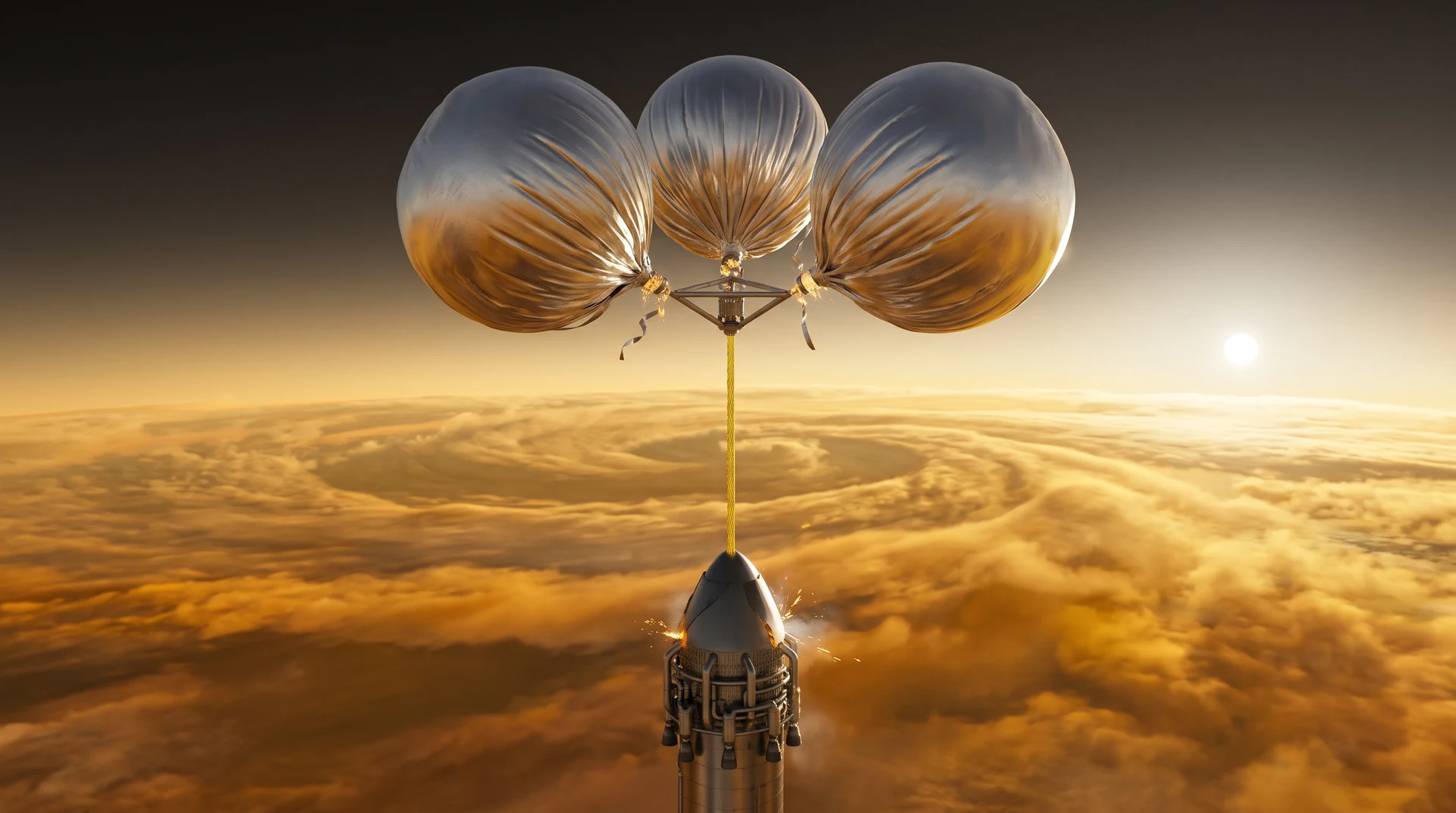
🔍 PN_loop 技術考証:Starship 空中フリップ展開と3連クラスター・エアロスタット の詳細を見る 🔍 PN_loop Verification: View Starship Mid-Air Flip & Triple-Cluster Aerostat Deployment
1. 解決・採用された決定事項(確定スペック・機構)1. Adopted Specifications & Mechanisms
- エアロキャプチャからの垂直姿勢フリップ:Starshipが金星大気圏(高度100km〜)で減速後、目標高度(約65km)到達直前にラプターエンジンを一瞬点火して垂直姿勢へ引き起こし、ノーズコーンからドラッグ・アンカー(パラシュート)と350mの高張力ケブラーワイヤーを展開する。Vertical Flip post-Aerocapture: After decelerating in the upper atmosphere, Starship briefly ignites its Raptor engines just above 65 km to flip vertically, deploying a drag anchor (parachute) and a 350 m high-tensile Kevlar tether from the nosecone.
- ペイロード分離と本体退避:エンジンと空タンクを積んだ重いStarship本体(約100トン)を切り離して下方へ滑空退避させ、軽量な「基地コアモジュール(約40〜50トン)」のみをワイヤーで吊るすことで必要浮力を劇的に削減する。Payload Separation & Hull Evasion: The heavy Starship hull (~100 tons) detaches and glides away, leaving only the 40–50 ton Base Core Module suspended on the tether, drastically reducing required buoyancy.
- 水素ハイブリッド・インフレーターによる瞬時充填:持参した少量の液体水素(4.5トン)を蓄熱カートリッジで瞬時に気化させ、コールドガス・スラスター技術を応用したインテークから3基のバルーンへ一気に噴射。数秒で総体積55,000 m³の初期浮力を獲得する。Instant Inflation via Hydrogen Hybrid Inflator: A 4.5-ton liquid hydrogen payload is instantly vaporized via a thermal cartridge and injected into the 3 balloons, achieving 55,000 m³ of buoyant volume within seconds.
- 3連クラスター・エアロスタットとリーフィング:120度配置の大型3連耐硫酸バルーン(PTFE/PFA被覆)を採用。展開初期の強風による膜の破断を防ぐため、絞り紐(リーフィング・ライン)を段階的に解除して3〜5分かけて球体へ移行させる。Triple-Cluster Aerostat & Reefing: Three large PTFE/PFA-coated balloons arranged at 120° intervals prevent membrane tearing in high winds by sequentially releasing reefing lines over 3–5 minutes.
2. 考証ハイライト(Positive初期案 vs Negative指摘 → 突破ギミック)2. Verification Highlight (Initial Concept vs. Critique -> Breakthrough)
- 初期構想(PT):アスピレーターで周囲の金星大気(CO2)を吸い込み、100〜150℃に加熱して「熱気球」として初期浮力を稼ぐ。200トンのStarship丸ごとを24個の小型気球で支える。Initial Concept (PT): Draw in ambient Venusian CO2 via aspirators and heat it to 100–150°C as a hot-air balloon, supporting the entire 200-ton Starship with 24 small balloons.
- 物理的課題(NT):50万 m³のCO2を数秒で150℃に加熱するには約64GJ(火薬20〜40トン分の爆発)が必要で成立せず、極寒の強風下では数分で冷えて墜落する。また24分割は膜の表面積(重量)が約3倍に増大し、減速時のワイヤー弛み(スラック現象)で気球同士が絡まる。Physical Flaws (NT): Heating 500,000 m³ of CO2 in seconds requires an impossible ~64 GJ and would cool and crash within minutes. Dividing into 24 balloons triples membrane surface weight and risks entanglement from tether slack.
- 解決アプローチ(Fix):Starship本体の分離投棄で吊り下げ重量を1/4に軽量化し、冷える熱気球を破棄して「4.5トンの水素膨張」による確実な浮力へ転換。さらに3連クラスター化で膜重量と絡まりリスクを同時に解消した。Breakthrough (Fix): Jettisoning the Starship hull cuts suspended mass to one-fourth; switching from hot CO2 to 4.5 tons of hydrogen ensures permanent buoyancy, while a 3-balloon cluster eliminates membrane weight penalties and entanglement.
PHASE 03 現地資源利用(ISRU)とメカノケミカル反応による化学変換 In-Situ Resource Utilization (ISRU) & Mechanochemical Conversion
- 濃硫酸(H2SO4)からの水素抽出:雲を構成する濃硫酸微粒子を捕集。ボールミル等の機械的エネルギーを利用する「メカノケミカル法」を採用し、地表から回収した金属粉末(Fe, Mg, Ti等)と摩砕・撹拌することで、常温・常圧下で金属表面の不動態膜を削り落としながら、高効率かつ高速に水素(H2)を生成・抽出する。Hydrogen Extraction from Concentrated Sulfuric Acid (H2SO4): Sulfuric acid aerosols harvested from the cloud deck are milled with metal powders (Fe, Mg, Ti, etc.) using ball-mill mechanochemical reactors. Mechanical impact continuously strips passivation layers from metal surfaces, generating and extracting hydrogen (H2) rapidly at ambient temperature and pressure without massive thermal furnaces.
- 二酸化炭素(CO2)の還元と燃料・資材化:メカノケミカル反応場において、抽出した水素を用いて大気中のCO2を機械的に還元(サバティエ反応等)。メタン(CH4)や水(H2O)、合成ガスを生産するとともに、鉱物粉末との結合による炭酸塩固定化(MgCO3, CaCO3等)を行い、基地の拡張資材や維持燃料として活用する。CO2 Reduction into Fuel & Structural Materials: Using extracted hydrogen within mechanochemical reactors, atmospheric CO2 is mechanically reduced (via Sabatier-type pathways) to produce methane (CH4), water (H2O), and syngas, while mineral carbonation (MgCO3, CaCO3) yields solid materials for base expansion.
PHASE 04 地表資源の採掘と耐過酷環境テクノロジー Surface Resource Mining & Extreme-Environment Robotics
- 耐熱・耐圧ロボティクス:500℃・90気圧・超臨界CO2流体・腐食性大気に耐えるため、冷却不要な炭化ケイ素(SiC)および窒化ガリウム(GaN)高温半導体回路、ガリウム系液体金属油圧駆動系、メカノケミカル式砕石ユニットを備えた自律型ローバーを投入。High-Temperature & High-Pressure Robotics: Autonomous rovers engineered for 500°C, 90 atm, and supercritical CO2 are deployed, featuring uncooled silicon carbide (SiC) and gallium nitride (GaN) high-temperature electronics, gallium-alloy liquid-metal hydraulics, and mechanochemical rock-crushing units.
- テセラ高地・地表採掘:玄武岩地帯および花崗岩質に近いとされる古高地「テセラ」へ着陸し、メカノケミカル反応の触媒・還元剤となる金属資源(鉄・マグネシウム・チタン)や、エネルギー生成に必要なリチウム(6Li)を採掘。Tessera Highlands Surface Mining: Landing on basaltic plains and ancient felsic 'Tessera' highlands to mine metallic reductants/catalysts (Fe, Mg, Ti) for mechanochemical ISRU alongside lithium (6Li) for fusion fuel breeding.
PHASE 05 重水素分離と自律型DT核融合発電サイクル Deuterium Separation & Autonomous D-T Fusion Power Cycle
- 重水素(D)の濃縮:金星大気中に地球の約120倍という比率で存在する重水素(HDO/H2O)を空中基地の精製プラントで分離・濃縮。Deuterium (D) Enrichment: Separating and enriching deuterium (HDO/H2O)—present in the Venusian atmosphere at ~120 times terrestrial abundance—within the aerial base's chemical refinement plant.
- トリチウム(3H)現地製造と核融合:地表から採掘したリチウム(6Li)および重水素に中性子を照射(6Li + n → 4He + 3H)してトリチウム(3H)を生成。In-Situ Tritium (3H) Breeding: Irradiating surface-mined lithium (6Li) and deuterium with neutrons (6Li + n → 4He + 3H) to breed tritium (3H) on site.
- 完全自給型エネルギー:回収した重水素と自給生成したトリチウムによるDT核融合発電を稼働させ、空中基地群および将来的な金星テラフォーミングの無制限な動力源を確立する。Self-Sustaining Fusion Energy: Operating D-T fusion reactors fueled by harvested deuterium and bred tritium, establishing a virtually limitless power source for expanding aerial habitats and long-term Venusian terraforming.
3.進捗・検討ログ 3. Progress & Engineering Logs
| 2026-11-10 |
正本を整理し、PN_loop の各お題の確定仕様(Fix_*.md)を設計の上流、本ページ(venus_data.json)を公開用の下流とする一方向の反映体制に移行。あわせて PHASE 02 と概要の気球展開の記述を確定仕様(持参した水素による初期充填)に合わせて修正。
Reorganized the source of truth: the finalized specifications from each PN_loop topic (Fix_*.md) are now the upstream design source, and this page (venus_data.json) is the downstream public summary, updated in one direction only. Also revised the balloon deployment descriptions in PHASE 02 and the overview to match the finalized specification (initial inflation with hydrogen brought from Earth).
|
| 2026-10-20 |
GrayDomain ポータルおよび「金星極域」ページの UI を刷新。oputo.com ナビゲーションと日英言語切り替え(en / ja)、および venus_data.json を正本とする日英同期ビルド体制を整備(ビルドツールは 2026-10-21 に sync_venus.py へ移行)。
Updated GrayDomain portal and 'Venus Polar Region' UI with oputo.com navigation, en / ja language toggle, and a bilingual synchronization build workflow based on venus_data.json (build tool migrated to sync_venus.py on 2026-10-21).
|
| 2026-10-19 |
全5段階の技術的ロードマップ(地球・月系からの遷移、エアロキャプチャ、月面マスドライバー補給、空中展開、ISRU、地表採掘、DT核融合)を統合した基本仕様書(_readme_Venus.md)を策定。
Established the master specification (_readme_Venus.md) integrating the 5-phase technical roadmap: Earth-Moon transit, aerocapture, lunar mass driver resupply, aerial deployment, mechanochemical ISRU, surface mining, and D-T fusion.
|
| 2026-10-17 | メカノケミカル法を用いた濃硫酸(H2SO4)からの常温・常圧水素抽出プロセス、および二酸化炭素(CO2)の機械的還元・炭酸塩固定化に関する化学的検証を実施。 Conducted chemical feasibility studies on ambient-temperature mechanochemical hydrogen extraction from concentrated sulfuric acid (H2SO4) and mechanical reduction/mineral carbonation of CO2. |